


Table of Contents:
- Understanding the H-1B Visa.
- Eligibility Requirements.
- Finding a Sponsoring Employer.
- The Application Process.
- Navigating the Lottery System.
- Common Pitfalls and How to Avoid Them.
- Post-Approval Steps.
- Conclusion.
The H-1B visa program remains one of the most critical paths for skilled professionals seeking employment in the United States. Each year, countless individuals from around the globe compete for this valuable opportunity, knowing that expert knowledge and careful preparation are essential for success.
To make the process smoother, understanding every phase of the journey can give applicants a meaningful advantage. For those looking for a detailed overview or regular updates, visit this helpful H-1B resource where complex immigration topics are explained for newcomers and seasoned professionals alike.
As the application process becomes more competitive, staying up to date on requirements and policies is critical. From confirming eligibility to finding an employer and tackling the US Citizenship and Immigration Services’ (USCIS) evolving lottery system, applicants need to approach each step methodically to increase their chances. Employers must also remain compliant with federal regulations to ensure smooth processing and prevent the loss of opportunities for talented employees. Preparation and attention to regulatory changes will help both applicants and companies navigate the system more confidently.
To better understand the broader context and statistics surrounding the visa process, check out this comprehensive guide from Forbes’ H-1B visa analysis, which discusses trends and government policy shifts.
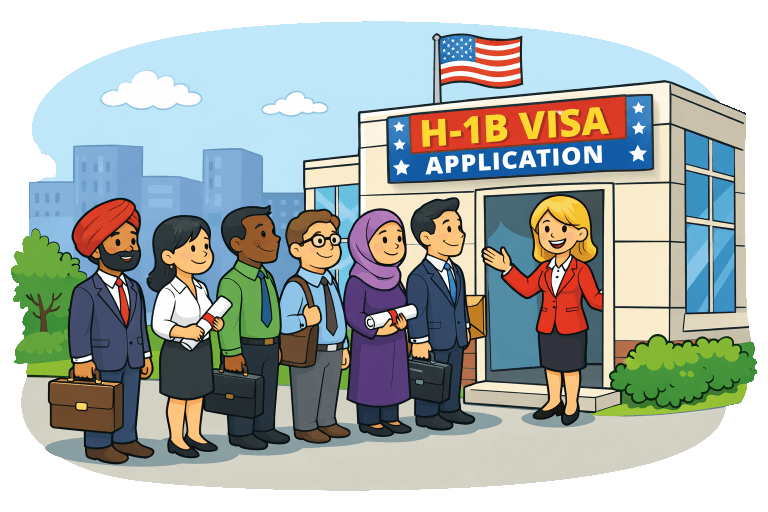
Understanding the H-1B Visa.
The H-1B visa permits US-based companies to employ international talent in specialized fields that demand technical or theoretical knowledge. These include information technology, engineering, mathematics, finance, and medical professions. In almost all cases, a prospective employee must have a unique skill set or background that is difficult to source in the domestic labor market. Without employer sponsorship, an applicant cannot pursue this visa independently, making mutual commitment central to the process.
Because of widespread demand, the H-1B has transformed careers and industries. With its complex rules and strict quotas, it serves dual functions: enabling companies to innovate while ensuring that qualified US workers are not displaced.
Eligibility Requirements.
Every H-1B hopeful must meet defined legal and professional criteria:
- Educational Qualification: Holding at least a bachelor’s degree or its equivalent in a relevant specialty is essential. Certain highly experienced candidates may also qualify via professional equivalency assessments.
- Specialty Occupation: The position offered must involve duties so specialized that only individuals with a particular background or degree can fulfill them efficiently.
- Employer Sponsorship: Only a US-based employer can initiate the process by extending a formal offer and preparing the requisite documentation with federal authorities.
Government agencies and nonprofit research institutions may sometimes sponsor applicants outside standard visa quotas, creating additional openings that can be less competitive.
Finding a Sponsoring Employer.
Landing a qualifying job with a US employer is the first tangible step toward H-1B approval. Professional networking is one of the most reliable paths to finding these roles. By building connections through sites like LinkedIn, attending job fairs, or actively participating in industry-specific events, candidates can raise their visibility among potential sponsors. Some established organizations regularly support foreign hires and often have streamlined recruiting programs specifically for the H-1B process. Others, particularly in research and nonprofit sectors, may offer positions exempt from traditional annual caps.
Exploring career paths in these less-crowded sectors may enhance your odds, especially if your background aligns with academic, scientific, or high-need public service roles. Check out the official USCIS list of specialty occupations for inspiration on which roles generally qualify.
The Application Process.
- Labor Condition Application (LCA): Your employer begins by filing a Labor Condition Application with the Department of Labor. This step verifies that hiring a foreign worker will not negatively impact wages or working conditions for Americans in the same field.
- Form I-129 Petition: With an approved LCA, the employer submits Form I-129 to USCIS. This petition details your role, salary, and the company’s background, as well as evidence of compliance with all visa requirements.
- Visa Stamping: For those outside the US, once the petition is approved, you will attend a consular interview in your home country to receive the H-1B visa stamp in your passport before traveling.
Each of these steps requires careful attention to timing and documentation since errors or delays may result in rejection or exclusion from that year’s quota.
Navigating the Lottery System.
Because the demand for H-1B visas regularly exceeds the annual statutory cap, a random lottery system is used to select eligible candidates. As of February 27, 2026, USCIS adopted a wage-weighted lottery, which assigns additional entries to candidates whose employers offer higher salaries or work in fields with greater skill shortages. While this system aims to reward merit and mitigate exploitation, it also adds new layers of strategy for both applicants and companies.
Common Pitfalls and How to Avoid Them.
- Incomplete Documentation: Missing paperwork or inconsistencies are among the leading causes of application denials. Maintaining detailed records and double-checking forms before submission is vital.
- Missed Deadlines: The H-1B calendar is rigid. Petitions that arrive late or outside registration windows will not be considered until the following cycle.
- Employer Non-Compliance: All fees must be paid by the employer, and job offers must remain fully in line with labor and compensation laws. Incorrect assumptions put both the company and the applicant at risk of denial.
Post-Approval Steps.
- Employment Changes: Major job changes, including role transitions or location moves, may require your employer to file an updated petition with USCIS.
- Visa Renewals: The H-1B is generally valid for 3 years, with extensions available for up to 6 years in total. Mark all expiration dates on your calendar and apply early for extensions to avoid status lapses.
- Permanent Residency: Many H-1B holders explore a transition to permanent residency, or a “Green Card,” for long-term stability. Beginning this process early can help minimize complications.
Conclusion.
An H-1B visa unlocks professional growth, cross-border collaboration, and a chance to contribute meaningfully to the US economy. Success demands a mix of diligence, organization, and strategic action by both applicants and employers. By proactively mastering each step of the process, foreign professionals can take confident strides toward working in the United States.
